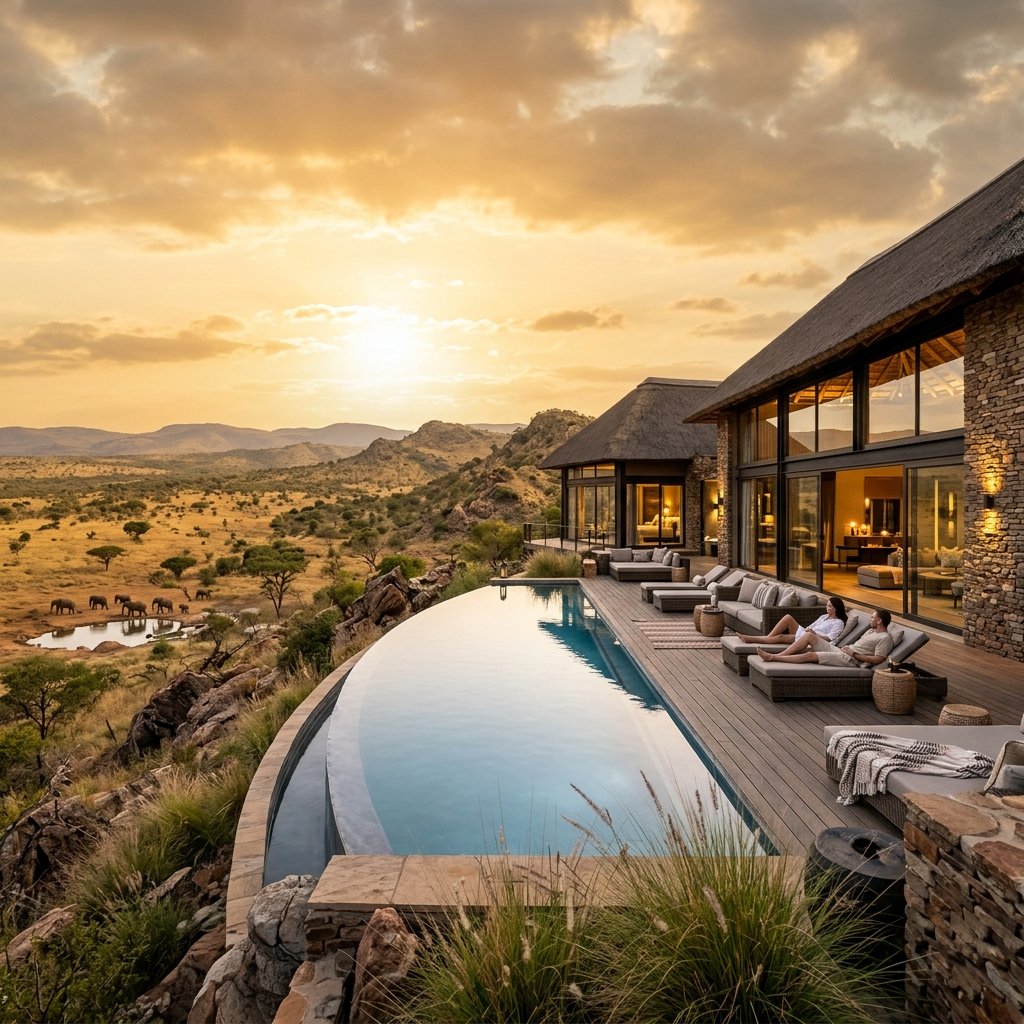
Private Wellness · South Africa

South Africa produces three kinds of private wellness project: the remote game reserve lodge or house, the winelands or coastal estate, and the city residence in Cape Town or Johannesburg.
They look similar on a brief and behave nothing alike in practice. A reserve is an engineering problem about power, water and distance from a service engineer. A city apartment is a problem about lifts, floor loading and neighbours.
This page is about telling them apart early, because the most expensive mistake is specifying one as though it were another.
South African private wellness enquiries come from three property types that share a country and very little else:
Often genuinely remote, frequently off-grid or part-grid, hours from a service engineer.
The constraint is not budget. It is power, water and whether anything can be maintained.
Stellenbosch, Franschhoek, the Garden Route. Mains services, established trades, and a building that is often heritage or heavily planned.
The constraint is usually what the structure and the planning permit.
Atlantic Seaboard, Constantia, Sandton, Bryanston. Apartments and houses with full services.
The constraint is access and neighbours: lifts, stairs, floor loading and noise.
Our judgement: the single most common error is specifying a reserve property as though it were a city one. Equipment that is unremarkable in Sandton can be unserviceable four hours from Nelspruit, and that is a design decision, not a logistics problem to solve later.
On a reserve or a remote estate, four questions settle the design before any equipment is chosen:
Given two options on a reserve, we will specify the one with fewer electronics and more serviceable mechanical parts. A device that cannot be kept running is worth less than a simpler one that can.
In Cape Town and Johannesburg the services are rarely the problem. Access is.
What decides feasibility in an apartment or a townhouse:
None of this rules a city installation out. It does mean the honest answer sometimes narrows the list — and it is cheaper to learn that from a drawing than from a crane quotation.
I Feel Spa International advises on South African projects from its Dubai base, working with local partners in Cape Town and Johannesburg for installation and commissioning.
Practical points that shape the programme:
For hotel, lodge and resort spa projects rather than private residences, see spa development in South Africa.
Tell us which, and where. On a remote property, the power and water answers shape the specification more than the budget does.
Start Your ProjectServices and distance. The real power supply (grid, generator, solar with battery, or a mix) and the actual water source and its quality decide what can be specified, and the nearest service engineer may be hours away. On remote properties we deliberately specify simpler equipment with more serviceable mechanical parts, and make sure wear parts are stocked on site — a device that cannot be kept running is worth less than a simpler one that can.
Often yes, but access decides it. Lift dimensions, stair turns and door widths need measuring before anything is ordered, because a float tank or hydrotherapy bath arrives in one piece. Floor loading for a filled bath or plunge is a structural question, pumps and chillers transmit noise through a building, and work affecting common property needs body corporate consent as part of the programme.
Customs clearance through SARS for specialised wellness equipment is usually the longest item in the schedule — more often than the manufacturing itself. We plan the programme around clearance rather than treating it as a formality, and we confirm servicing and parts availability in country before purchase.
Yes, and it is one of the few places where that choice is genuinely distinctive rather than decorative. The Cape Floristic Region supports an unusually rich indigenous plant palette, and a ritual built around it reads as South African instead of as an imported concept dropped into the country.
 Irina Filippova
Chief Architect, I Feel Spa International
Leads interior design and architectural consultancy across I Feel Spa International’s global portfolio. Creator of award-winning spa interior concepts across Russia, the CIS and the Middle East.