Private Wellness · Africa & Indian Ocean
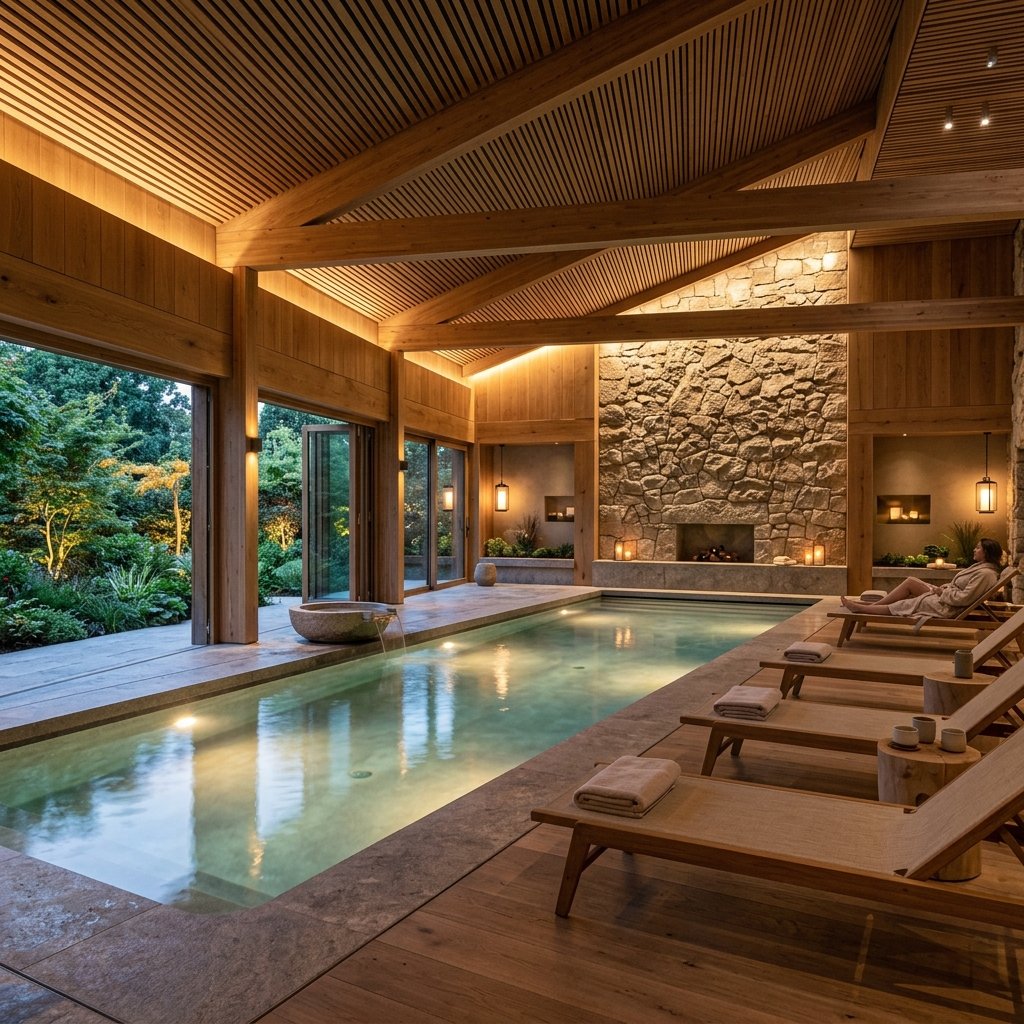
A Russian banya and a Vichy shower are the two installations private clients in Africa and the Indian Ocean ask us for most often, and the two that most often go wrong.
Neither is a product you buy and place. A banya is a building. A Vichy shower is a wet room with a treatment table in it. Both were developed in cool northern climates and are being installed in heat, humidity, salt air and, often, somewhere a replacement part takes weeks to arrive.
This page is about what that changes. The devices themselves are described on our wellness technologies pages.
The banya and the Vichy serve opposite halves of the same ritual. The banya is dry-built heat with a cold contrast; the Vichy is warm water delivered over a reclined body by a therapist. Together they give an estate both a self-directed session and a treatment that needs someone to run it.
That second word is the one to sit with. A Vichy shower only works if somebody is standing over the table:
Our judgement, from estates that called us after the build: if you will not employ or regularly bring in a therapist, install the banya and a good cold plunge, and spend the Vichy budget on the heat room instead. It will be used ten times as often.
The requirements below are the ones most often discovered after the structure is finished, when they are expensive rather than trivial.
A built room, not a delivered unit — heat-tolerant structure, an internal vapour barrier, and timber selected for repeated heat and moisture cycling. In the tropics that specification also has to account for humidity and insects, which rules out some of the timbers used for banyas in Europe.
Heat sourceA wood-fired stove needs a flue, a fuel store, a supply of dry wood and, in most jurisdictions, a fire approval. An electric heater needs none of those but a substantial dedicated circuit — which on a generator-backed estate has to be checked against the generator, not just the mains.
Around itDrainage, ventilation that clears moisture to outside rather than into the roof void, and the cold contrast — plunge, shower or pool — immediately adjacent and reachable barefoot.
Full tanking, falls designed into the slab toward a drain sized for a continuous high flow, and finishes that survive constant wetting. This is the item that cannot be retrofitted cheaply: it is structural, and getting it wrong means taking the floor up.
WaterA sustained flow of tempered water at a stable temperature for the length of a treatment. On estates drawing from a borehole, a tank or a desalination plant, that steadiness is the constraint — and water quality decides what the jets and valves will tolerate.
Working spaceRoom for a therapist to move along both sides of the table, somewhere for the guest to change and shower, and ventilation that clears the humidity so the room dries between treatments.
Four of these are services decisions — drainage, ventilation, power, water — and all four are settled on a drawing in an afternoon. After the slab is poured they are a demolition job.
Both installations were developed where the air outside is cold. Almost everything that differs in Africa and the Indian Ocean follows from the fact that it is not:
None of this makes a banya or a Vichy a bad idea in the tropics. Both work extremely well here. It means the specification is a local one, and a package quoted for a European installation is the wrong starting point.
On an island or a bush estate, the questions that decide whether an installation is still working in five years are asked before the order, not after it.
We would rather specify a simpler banya that the household can keep running than an elaborate one that stops working the first time a controller fails.
For a new build or a major renovation, the sequence that avoids almost all of the above:
The limit of this: plenty of estates come to us with the building finished and the question of what can still be done. The answer is usually more than owners expect for a banya, which can often go into an outbuilding or a garden structure, and less than they hope for a Vichy, which needs the drainage it needs. Knowing which before you commit is the point.
Send us the plan and tell us where the estate is. We will tell you what the building and the location can take.
Start Your ProjectYes, and it works well, but the cold side has to be manufactured rather than borrowed from the weather. A banya in Africa or the Indian Ocean needs an actively chilled plunge or cold shower immediately beside it, ventilation designed to clear moisture to outside rather than into the roof, and timber chosen for humidity and insects rather than for a European specification. Given those, the ritual is unchanged.
Only if a therapist will use it. A Vichy shower is a treatment delivered by one person to another, so without a therapist on staff, visiting regularly, or a household large enough to justify one, it becomes a very expensive shower. Where there is no therapist, we usually advise putting the budget into the heat room and the cold plunge, which the household will use far more often.
A banya needs heat-tolerant construction, a vapour barrier, a flue and fuel store for a wood stove or a substantial dedicated circuit for an electric heater, drainage, ventilation and an adjacent cold plunge with a route to open air. A Vichy needs a fully tanked wet room with falls to a large drain, a sustained supply of tempered water, space for a therapist to work both sides of the table, and ventilation that dries the room between treatments.
The access route for the largest component, the quality of your actual water rather than an assumed supply, the power available including generator capacity, who will maintain the installation day to day, and where wear parts come from and how long they take. On remote sites we prefer a simpler specification whose spares can be stocked on site over a more elaborate one that cannot be serviced locally.
 Irina Filippova
Chief Architect, I Feel Spa International
Leads interior design and architectural consultancy across I Feel Spa International’s global portfolio. Creator of award-winning spa interior concepts across Russia, the CIS and the Middle East.