When we tell clients that the compass orientation of their bedroom influences their sleep quality, their energy levels and even their financial thinking, reactions vary. Sceptics smile. Those who have lived in a correctly oriented home nod knowingly. Then we show the chronobiology data — and the sceptics start asking different questions.
Vastu Shastra is the ancient Indian science of space, formed more than 5,000 years ago. Its principles are based on the interplay of five elements — earth, water, fire, air and space — orientation to the cardinal directions, and the organisation of energy flows through a building. Looked at closely, many of these principles coincide with what modern building biology and chronobiology have rediscovered.
The key principles of Vastu — and what science sees in them
- Main entrance to the east or north-eastThis is no arbitrary rule. An eastern entrance maximises the penetration of morning sun into the living space. Morning light synchronises the circadian rhythm through the retina: it stimulates cortisol release (the hormone of wakefulness and productivity), suppresses residual melatonin and activates the serotonergic system. You wake up not because an alarm went off — but because the house placed you in the correct biological conditions.
- Kitchen to the south-eastThe fire element is associated with the south-east. Practically: in the morning the south-eastern part of the house receives enough sun to light the cooking zone naturally, while prevailing winds carry heat and cooking smells away from the living areas. This coincides with passive-ventilation principles in modern eco-design.
- Sleeping with the head to the south or eastThe Earth’s geomagnetic field runs from north to south. A number of studies (including Ruhenstroth-Bauer et al.) have recorded differences in sleep quality depending on body orientation. A south-east head position also aligns with circadian guidance: an east-facing bedroom receives morning sun, triggering a gentle awakening without an alarm.
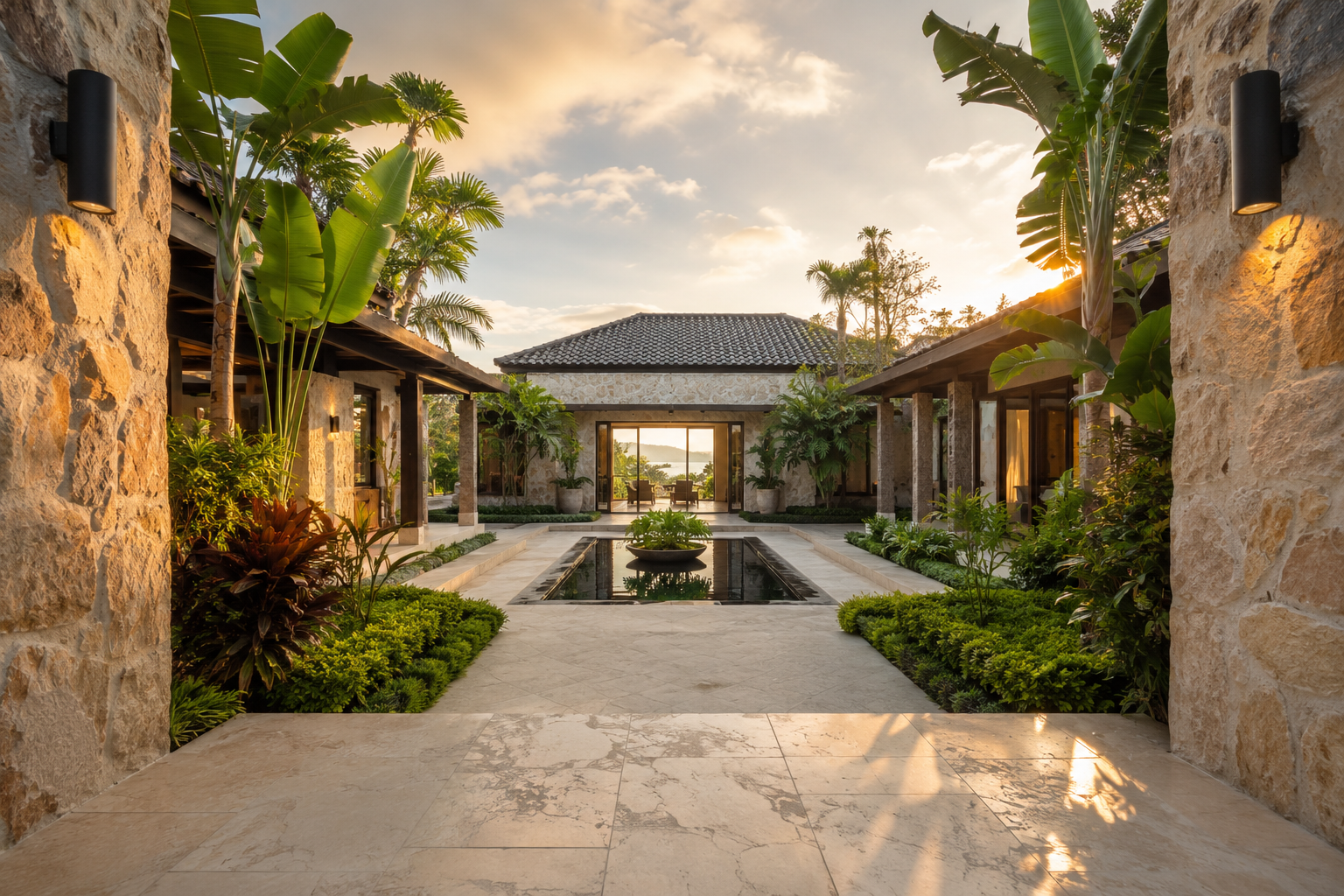
- Brahmasthan: the centre of the home stays openUnder Vastu, the central zone of a home should remain open — no load-bearing columns, stairs or heavy objects. This echoes the architectural principle of the “breathing core”: an open centre enables cross-ventilation, even distribution of natural light and freedom of movement — three factors that improve air quality and psychological comfort.
- North-east: the zone of water and meditationEnergetically the calmest zone. In modern terms: the north-eastern part of the house receives soft, even light without direct sun — optimal conditions for meditation, concentration work and yoga. Placing a pool or water element here delivers a cooling effect in hot climates (the Middle East, Bali, Thailand).
The flagship: Eywa in Dubai
Eywa is an ultra-luxury residential project by developer R.Evolution in Dubai, designed on Vastu Shastra principles combined with EMF shielding and bio-harmonic design. The project is certified under LEED, WELL and WiredScore — the first “living building” in Dubai to hold Platinum status under all three standards simultaneously. Its pricing sits, predictably, at the top of the market.
The Dubai market records premiums of up to 25–30% for wellness residences that integrate such concepts. Vastu here is not mysticism for buyers from India. It is an architectural system that helps sell — and justify — a higher price.
Our approach: Vastu as one of the lenses
We do not absolutise any single system. Vastu Shastra is one language in which space and its influence on people can be described. Alongside it stand neuroarchitecture, biophilic design, chronobiology and medical science. They all say the same thing in different words.
When we design a villa on Palm Jumeirah, a residence on Santorini or an estate on Mauritius, we overlay all of these layers. Orientation to the cardinal directions is the first parameter we analyse — because after construction, it is impossible to change.
I Feel Spa International unites Vastu Shastra, chronobiology, biophilia and medical knowledge into a single architectural protocol for premium longevity residences.