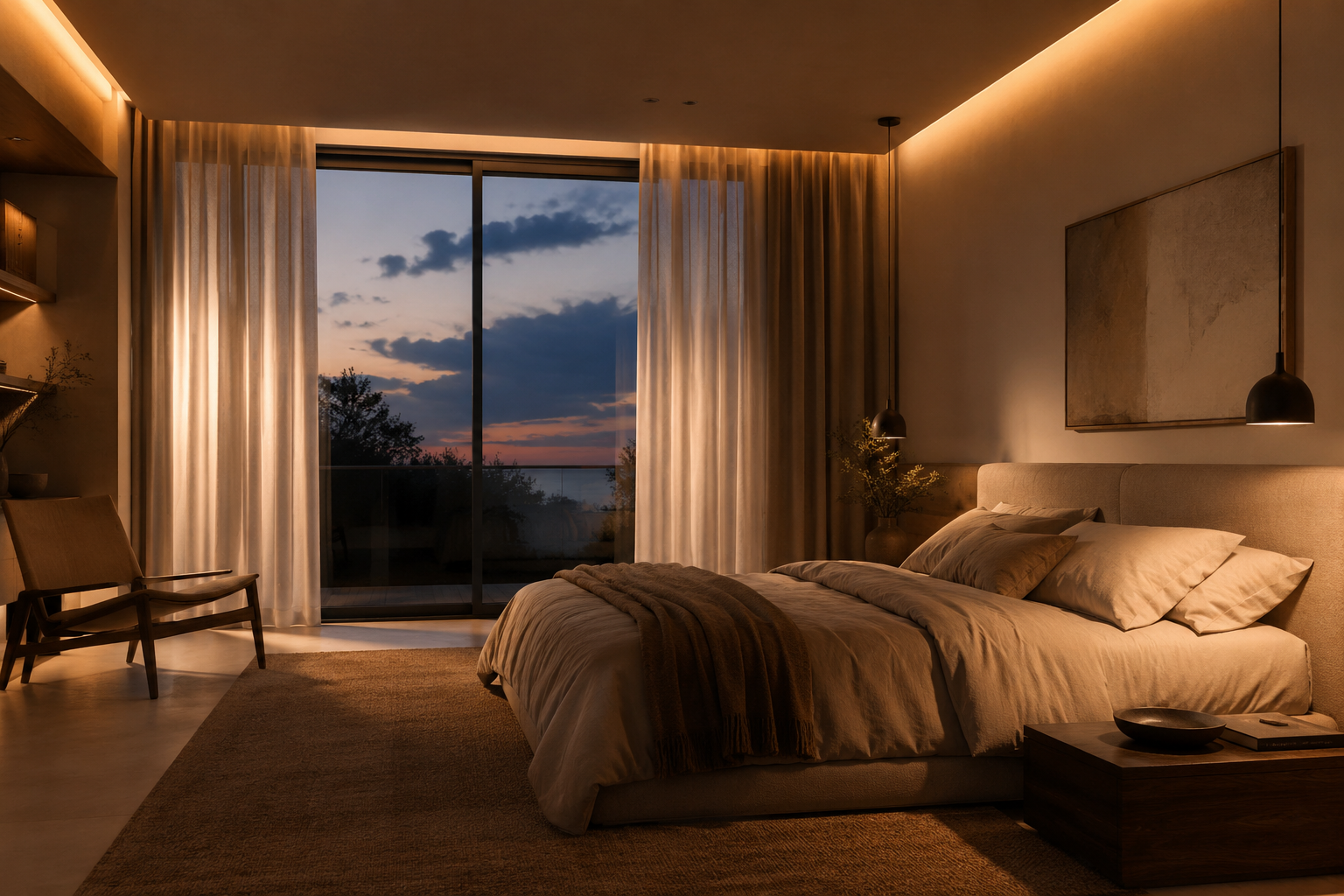
Have you noticed that in some homes you fall asleep easily and wake up rested, while in others you toss for hours and rise exhausted? It is not just the mattress. It is how the house interacts with your biological clock.
The circadian rhythm is the 24-hour biological cycle that governs virtually every physiological process: cortisol and melatonin levels, insulin sensitivity, inflammation regulation, the rate of cellular repair. Circadian disruption is linked to elevated risk of type 2 diabetes, cancer, depression and accelerated ageing.
Morning: the architecture of awakening
Research in Scientific Reports (Nature, 2019) showed that artificial light at night suppresses melatonin production by around 40% within minutes. The symmetrical process works in the morning: bright blue-spectrum light (460–480 nm) shifts the circadian phase forward, stimulates the cortisol awakening response and activates the serotonin system.
In architectural terms this means: the bedroom must be able to receive bright natural light in the morning. An eastern or south-eastern bedroom orientation. Automated curtains that open at a programmed time. A circadian lighting system that simulates sunrise when natural light is insufficient.
Day: space for peak performance
Average illuminance in an ordinary home is 100–300 lux. Outdoors on a clear day it is 10,000–100,000 lux. That difference is critical for the hypothalamus. Insufficient daytime light blurs the circadian signal, lowers serotonin, and degrades mood and concentration.
The solutions: generous glazing (a minimum window-to-floor ratio of 15–20% for living rooms), light wells for internal zones, atriums, glazed roofs. The work zone gets maximum illuminance, ideally with a view of natural landscape. This is not a design preference. It is a physiological requirement.
Evening: the architecture of transition
After sunset, blue light must gradually give way to warm amber (2700–3000 K). This is not the aesthetics of a cosy evening — it is the brain’s preparation for melatonin production. The pineal gland responds to the light signal through the retina: blue light in the evening is the command “still day.” Warm light is the command “night is coming.”
Architectural measures: a dual-mode lighting system (day/evening), exclusion of high-colour-temperature LEDs from living zones in the evening, and warm low-level lighting of stairs and corridors for night movement without waking the nervous system.
Night: the architecture of recovery
The bedroom is the most important room in the house from a longevity standpoint. This is where cellular repair, memory consolidation and the brain’s detoxification through the glymphatic system (active only during sleep) take place. The architectural requirements:
- DarknessShading that blocks 100% of external light. Even faint light through the eyelids suppresses the deep phases of sleep.
- SilenceAcoustic isolation from street and household noise. Night-time noise above 40 dB raises the risk of cardiovascular events (WHO).
- TemperatureThe optimal sleeping temperature is 16–19°C. A bedroom climate-control system isolated from the rest of the house is not an option — it is an architectural standard.
- Electromagnetic hygieneAll actively transmitting devices stay outside the bedroom. Wired connections replace Wi-Fi wherever possible.
Circadian lighting as a technology
Human Centric Lighting (HCL) systems are already being integrated into luxury residences worldwide. They program the change of light spectrum and intensity across the day, synchronising the home with the biological clocks of its occupants. This is not a gadget. It is a medical technology transferred into architecture.
Combined with correct building orientation, automated shading and intelligent zoning, circadian architecture creates an environment in which the hormonal system stays within its optimal corridor — with no conscious effort from the occupant at all.
I Feel Spa International designs circadian architecture for luxury residences in the UAE, Qatar, Greece, Spain and other markets. After space itself, light is our most important instrument.