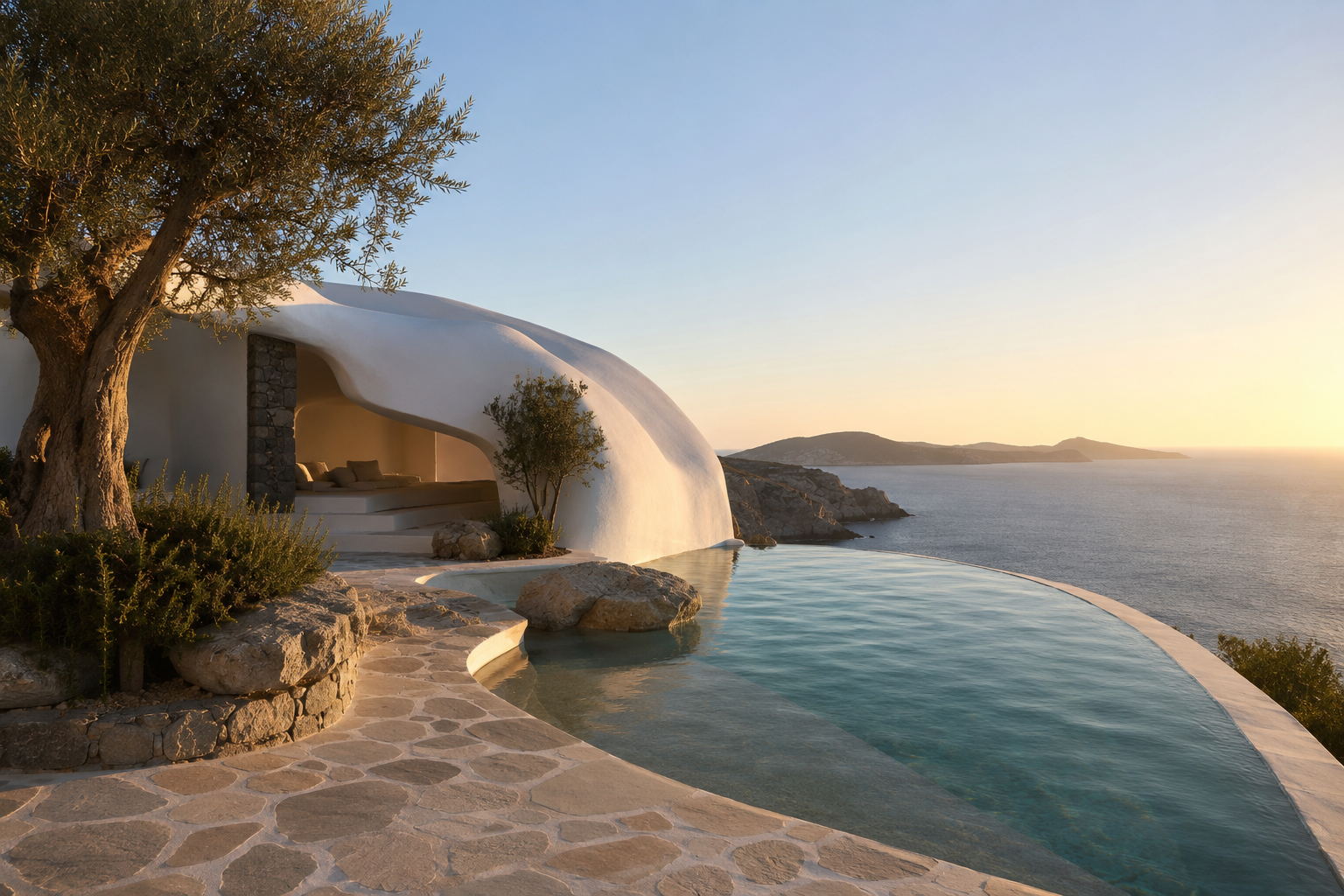
Longevity architecture has no single style. In a palace on the Aegean shore it looks different from a villa amid Ubud’s rice terraces or a penthouse above Dubai Harbour. But the principles are the same. Materials, climate and cultural context change — human biology does not.
A review of the key markets and flagship projects shaping the new standard of luxury living.
UAE: the laboratory of the future
Dubai today is the world’s laboratory of wellness real estate. The concentration of flagship projects per square kilometre is unprecedented.
- Eywa (R.Evolution)Arguably the most technologically advanced residential project in the world right now. Every residence is designed to Vastu Shastra principles with EMF shielding and bio-harmonic design. 59 shared wellness amenities. Triple Platinum certification: LEED, WELL, WiredScore.
- Six Senses Residences Palm JumeirahA 60,000 sq ft wellness club including a longevity clinic, IV therapy, biohacking zones, hyperbaric chambers and cryotherapy. No longer a hotel spa — a medical centre inside a residential complex.
- Vincitore Wellness Estate (Majan), DAMAC Lagoons, Shamsa VillasVincitore announces a one-kilometre floating forest, salt caves and infrared saunas. DAMAC Lagoons is building wellness clusters. Shamsa Villas at Expo City orient to Blue Zones principles — the regions of the planet with the highest concentration of centenarians.
The market signal: UAE developers record premiums of up to 25–30% for wellness concepts. The UAE grew from $3.3 billion to $14.6 billion in wellness real estate between 2019 and 2025.
Saudi Arabia: the fastest-growing market
Saudi Arabia is the most explosive market: from $200 million in 2017 to $28 billion by 2025. State mega-projects (NEOM, the Red Sea Project, Diriyah) integrate wellness architecture as a systemic element — not an option. Vision 2030 makes the nation’s health a strategic priority, and architecture has become part of that programme.
Greece: wellness against the backdrop of eternity
Greece is living through a branded-residence boom. One&Only Kéa Island, Mandarin Oriental at The Ellinikon, Four Seasons Astir Palace, Six Senses Porto Heli — reality, not announcements. Ralph Lauren Residences in Crete and Foster + Partners’ Riviera Tower (Greece’s first green residential high-rise) set a new bar.
Euphoria Retreat in Mystras is perhaps the most conceptually powerful longevity project in the Mediterranean: its Ef Zin (“good living”) philosophy joins ancient Greek concepts of health with modern medicine. Daios Cove offers cryotherapy and hyperbaric treatment on the Aegean shore.
Greece’s architectural context is unique: orientation to the sea, the climate, native stone and terracotta are ready-made biophilic materials. The architect’s task is not to add wellness — it is not to spoil what is already there.
Spain: longevity medicine meets architecture
Lanserhof Marbella (opening 2027) will unite German evidence-based longevity medicine with the Spanish climate and architecture — one of the most anticipated projects in Europe. Spain leads European growth in the wellness segment: +46% over 2019–2025. Barcelona is actively developing biophilic urban quarters.
Bali: nature as the architect
Bali is where longevity architecture was invented long before the term existed. COMO Shambhala Estate in Ubud has worked with the concept of a “journey to oneself” through environment for two decades. The local architectural school — bamboo, volcanic stone, open bale pavilions, orientation toward Mount Agung — aligns organically with biophilic principles.
The growing wellness-villa market (Ubud, Uluwatu, Canggu) shows net yields of 12–15% for correctly designed properties. One caveat: the 2025 moratorium on new construction requires careful legal analysis.
Thailand: wellness as national strategy
Phuket hosts the Global Wellness Summit 2026 — an indicator that Thailand is deliberately positioning itself as Asia’s wellness hub. The government programme for medical wellness tourism includes architectural standards for certified wellness residences.
Mauritius and the Seychelles: tax haven with wellness integration
Mauritius attracts HNWI clients through the PDS scheme (Property Development Scheme): property purchase from $375,000 brings residency, with no capital gains or inheritance tax. The number of wealthy residents grew from 3,500 (2016) to 4,500+ (2025). Branded residences (Anantara Residences, Heritage Villas Valriche) actively integrate wellness architecture; Anahita Beau Champ is setting a new wellbeing standard in the Indian Ocean.
The Seychelles: The Residences at Meliá on Mahé (Eden Island, 68 residences) with a guaranteed 5% yield for first buyers — an example of wellness real estate with financial engineering.
South Africa: world-class architectural expertise
Cape Town studio SAOTA is one of the global leaders in luxury residential. Their projects unite indoor-outdoor living, biophilic design and connection to the landscape at a level that has become a benchmark. The growing local wellness segment in Cape Town and along the peninsula is creating demand for longevity elements within the traditional Cape Contemporary style.
I Feel Spa International works across all of the markets above. We do not merely know these locations — we understand their building codes, their cultural context and their clients’ expectations.