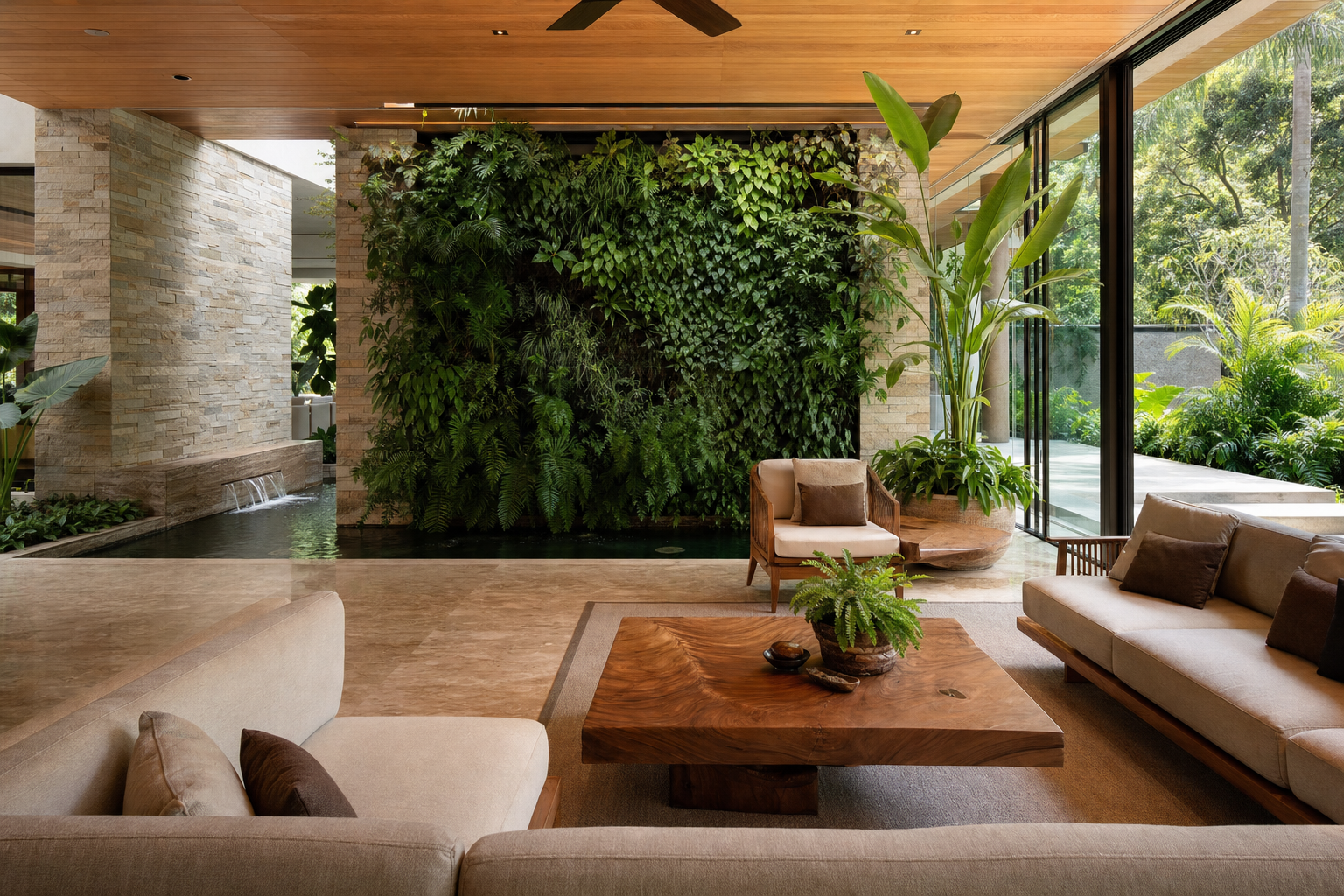
Imagine walking into a room with a high ceiling, a flood of natural light, living greenery by the window and the quiet sound of water. Within minutes your pulse slows, your shoulders drop, your breathing deepens. That is not psychology. It is biochemistry. And it can be built into architecture.
Biophilia is the innate human need for connection with nature. Millions of years of evolution shaped a nervous system that literally calms down at the sight of greenery, water, natural forms and materials. Biophilic design is the architectural language that speaks to your brain on an evolutionary level.
What the science says
In 2015, the large-scale Human Spaces study surveyed 7,600 office workers in 16 countries. The conclusion: people working in environments with natural elements report 15% higher wellbeing, 6% higher productivity and 15% higher creativity. These are not feelings. They are measured outcomes.
A 2024 systematic review (Frontiers in Built Environment, covering research from 2010–2023) in healthcare settings found that biophilic design shortens hospital stays, reduces pain levels, accelerates recovery and lowers staff stress. Nature heals — even when it is simply present in the field of view.
Researchers at the University of Exeter recorded improved memory and attention when plants were present in the workspace. Heschong (2003) showed that moving call-centre workstations next to a window increased operator productivity by 6%.
The mechanism: why it works
Biophilia lowers cortisol — the stress hormone. Looking at nature activates the parasympathetic nervous system. Blood pressure and heart rate fall. A 2018 study (Harada et al.) showed that the aroma of linalool — a component of lavender — activates the same neural pathways as tranquillisers such as Valium, without the side effects.
A 2021 German study (Grote et al.) established that sleeping in a bed made of stone pine improves cardiovascular indicators during the night. The scent of natural wood literally changes the physiology of sleep.
The 14 patterns of biophilic design: what we use
Bill Browning of Terrapin Bright Green systematised the 14 patterns of biophilic design. In our work we apply them adapted to the climate and culture of each region:
- Visual connection with natureFloor-to-ceiling windows, open verandas, patios, atriums with living plants — direct visual contact with nature lowers physiological stress markers after as little as five minutes of exposure.
- Non-linear forms and fractalsNature has no right angles. Organic curves in architecture and fractal-like patterns — as in leaves, waves and stone — induce a state of “soft fascination” in the brain: relaxed attention close to meditation.
- Living materialsWood, stone, bamboo, natural fibres — they change with time, breathe and carry scent. This is not merely aesthetics. These are safety signals for the nervous system.
- Water as an elementThe sound of water reduces activity in the amygdala — the brain’s anxiety centre. A pool, waterfall, stream, even a small basin in an atrium is a therapeutic intervention with an architectural expression.
- Light as a living elementDynamic lighting that changes through the day with the sun supports the circadian rhythm. Blue-spectrum light in the morning — cortisol and alertness. Warm amber in the evening — melatonin and recovery.
Biophilic design in luxury villas: what clients are asking for
Across the UAE, Greece, Bali, Mauritius and the Seychelles, high-net-worth clients increasingly write biophilia into the architectural brief: living walls in the living room, green roofs, gardens on every level, integrated natural stone, open sea-water plunge pools, and a seamless connection between inside and outside through folding facades.
Dubai’s flagship Eywa project integrates biophilia at the level of concept: every residence is designed around principles of balance with nature, including EMF shielding and bio-harmonic design. This is no longer avant-garde — it is the new standard.
What this looks like in a real project
In our practice, biophilic design is a mandatory layer of every longevity project. We start with an analysis of the climate, the orientation and the dominant views from the site. Then we build the architectural response: window placement, material selection, a ventilation system with living green filters, and a garden organised as a continuation of the living space.
The result is a home in which the body recovers automatically. Without effort. Simply because it was designed that way.
I Feel Spa International designs wellness residences with full biophilic integration — from concept to construction supervision. From our Dubai base we serve clients across the UAE, Qatar, Greece, Spain, Bali, Thailand, South Africa, Mauritius, the Seychelles and the USA.