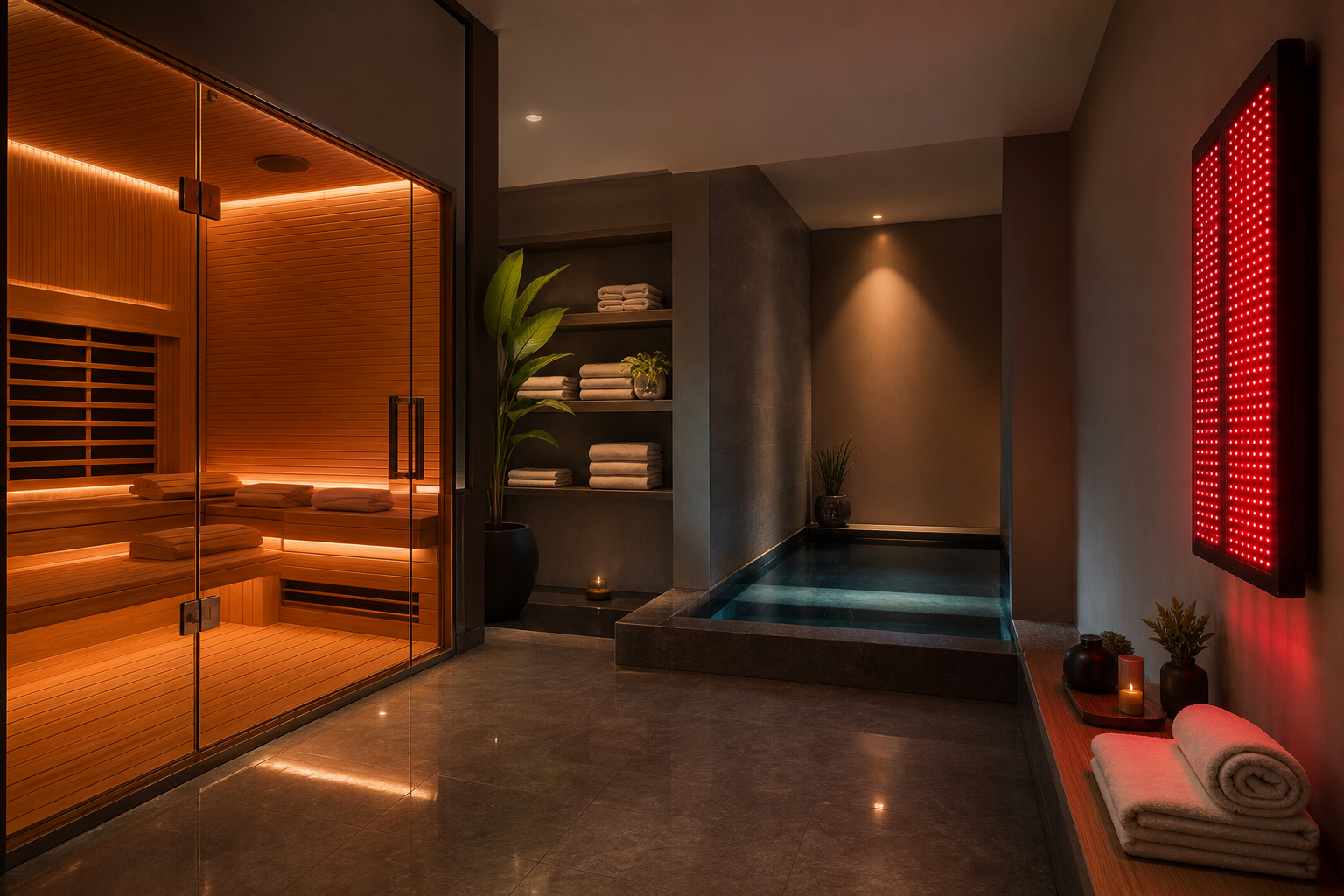
Home recovery zone — private wellness room with infrared sauna and float pool
Blog · Recovery & Longevity

Home Recovery Zone: Building a Recovery Clinic Into the Architecture of Your Home

Infrared sauna, cryotherapy, flotation, photobiomodulation — architectural solutions for the luxury villa

20–30%
Cortisol drop after flotation (63 studies)
+30–40%
ATP output under photobiomodulation
−38%
Wrinkles after 12 weeks of red light
20–120 m²
From wellness niche to longevity wing

Recovery used to mean travelling to a spa hotel or a medical centre. Today everything has changed. Discerning clients around the world — from Palm Jumeirah to Bali and Mauritius — expect deep recovery to be built into the home itself. Not as an option. As part of the architecture.

A home recovery zone is not simply a room with fitness machines. It is a designed space in which several therapeutic technologies work synergistically to restore the body at the cellular level — and in which the architectural systems (ventilation, water supply, power, acoustics, finishes) are an integral part of the therapeutic protocol.

The technologies that work: the evidence base

  • Infrared saunaDeep tissue warming (unlike a traditional Finnish sauna, which heats the air) improves peripheral circulation, stimulates detoxification through sweat and reduces inflammation. The Japanese Iyashî Dôme infrared capsule with its Black Carbon catalyst is one of the most technologically advanced formats: no-touch, uniform heating, minimal cardiovascular load. It is the very device installed at the Dior Spa in The Lana Dubai.
  • Photobiomodulation (red and near-infrared light)Wavelengths of 630–680 nm and 810–850 nm penetrate tissue and stimulate cytochrome c oxidase — the key enzyme of mitochondrial respiration. The result: ATP production rises by 30–40%. A 2023 clinical study recorded, after 12 weeks of photobiomodulation, 38% fewer wrinkles, 48% greater dermal density and 24% more skin elasticity. A 2018 meta-analysis of 22 randomised controlled trials (Lasers in Medical Science) confirmed its effectiveness for muscle recovery. The Cleveland Clinic recognises a high level of evidence for a number of indications.
  • Flotation (sensory deprivation)A 2026 systematic review (63 studies, more than 2,400 participants) recorded a 20–30% reduction in cortisol after a flotation session. Theta brain waves activate — a state of deep recovery. The parasympathetic nervous system takes over. Effects persist from two to seven days after a single session. A flotation pool or capsule at home is architecturally demanding (water supply, ventilation, sound insulation), but entirely solvable with competent design.
  • CryotherapyCold exposure (−110°C for 1–3 minutes) triggers a powerful anti-inflammatory response, a norepinephrine release, and accelerated muscle recovery. Home cryo-chambers exist but require professional installation, dedicated ventilation and safety systems. A lower-threshold alternative — contrast shower zones and cold plunge pools — is far simpler to integrate.
  • Hyperbaric oxygen therapy (HBOT)Research in Frontiers in Aging (2024, Gupta & Rathored) documents telomere-length support, angiogenesis and collagen production with regular HBOT sessions. Harvard Health (December 2024) urges a clear distinction between proven indications and marketing claims. Soft-shell home hyperbaric chambers are a realistically integrable solution that requires no clinical licence.
  • EMS recovery: reLoungeAn EMS lounger for passive muscle recovery — a solution for chronic back fatigue, muscular tension or the after-effects of stress. It occupies minimal space and needs no special engineering. Regular use reduces pain and anxiety levels.
  • PelviPower and pelvic-floor healthRPMS technology (repetitive pelvic-floor magnetic stimulation) addresses one of the least visible yet most significant aspects of ageing physiology. The PelviPower chair integrates into any space and works quietly in the background. Relevant for both sexes, particularly after 40.
A recovery zone cannot be added as an afterthought. It must be written into the project from the very first drawing.

Architectural requirements: what must be planned at the design stage

SystemRequirementWhy it matters
ElectricalDedicated power circuits with correct earthingInfrared devices, HBOT and EMS carry high loads
VentilationDedicated extraction with air dehumidificationHigh humidity after sauna and flotation; mould protection
Water & drainageSeparate supply with filtrationFlotation pool, plunge pool and shower zones
AcousticsSound isolation from the rest of the houseFlotation requires complete silence
FinishesAntibacterial, moisture-resistant, non-toxic materialsFunctional necessity, not just aesthetics
Light controlProgrammable modes per therapyFlotation — total darkness; photobiomodulation — controlled red light; activation — bright daylight

How much space does it take?

A minimal home recovery zone starts at 20–25 m². A full longevity wing in a villa runs from 60 to 120 m². Depending on the technology set, budget and architectural context, we design everything from compact wellness niches to dedicated wings with a complete spectrum of recovery protocols.

I Feel Spa International designs home recovery zones turnkey: from concept and technical brief to design supervision. We work directly with the leading wellness-technology manufacturers and know how to integrate the equipment into the architecture — not simply “place it in a room.”

FAQ

Frequently asked questions

A home recovery zone is a purpose-designed space in a private residence where several therapeutic technologies — infrared sauna, flotation, photobiomodulation, cold therapy, EMS — work synergistically to restore the body at the cellular level. The architecture itself (ventilation, water, power, acoustics, finishes) is an integral part of the therapeutic protocol.

A minimal home recovery zone starts at 20–25 m². A full longevity wing in a villa typically occupies 60–120 m², depending on the technology set, budget and architectural context — from compact wellness niches to dedicated wings with a complete recovery protocol.

It is far better to plan it from the start. Infrared equipment, HBOT and EMS need dedicated power circuits with proper earthing; saunas and flotation require dedicated extraction with dehumidification; flotation pools and plunge pools need separate water supply, drainage and filtration; and flotation demands full acoustic isolation. Retrofitting all of this is possible but significantly more complex and costly.

Photobiomodulation is supported by a 2018 meta-analysis of 22 randomised controlled trials for muscle recovery, with clinical work showing significant skin improvements after 12 weeks. Flotation shows 20–30% cortisol reduction across a 2026 systematic review of 63 studies. Infrared sauna improves peripheral circulation and reduces inflammation. HBOT shows telomere and collagen effects in recent research, though experts advise separating proven indications from marketing claims.

Whole-body cryotherapy chambers (−110°C) exist for home use but require professional installation, dedicated ventilation and safety systems. A lower-threshold alternative with much simpler integration is a contrast shower zone or a cold plunge pool, which deliver comparable cold-exposure benefits for most users.

Recovery At Home

Build a recovery clinic into your home

From a compact wellness niche to a full longevity wing — designed turnkey with the world’s leading wellness-technology manufacturers.

Start Your Project